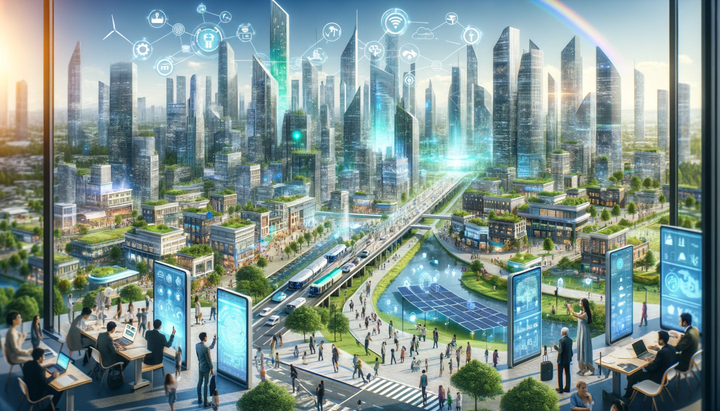
Smart City Innovation: Drawing a Blueprint for the City of the Future
Smart city innovation refers to the use of advanced technologies—such as sensors, data analytics, digital twins, AI, and IoT—to improve urban living. It exists to tackle challenges faced by growing cities: congestion, environmental stress, aging infrastructure, and unequal service access. By digitally integrating city systems, officials can make informed decisions, optimize resource use, and enhance quality of life for all residents.
Importance: Why This Matters Today
Improving Urban Services
Smart systems help manage public transport, energy, waste, emergency response, and more with real-time efficiency. For example, sensor-driven waste bins reduce collection costs by up to 80% in dozens of cities worldwide
Enhanced Safety and Resilience
Digital twins—accurate 3D models of city sections—enable simulations for disasters, traffic, and infrastructure breakdowns. Seoul now uses such systems to test disaster responses before they happen
Sustainability and Environmental Gains
By analyzing traffic flows and emission levels, cities can reduce pollution and emissions. Portugal’s S-Map in Seoul models wind paths and air-quality impacts ─ a blueprint for greener urban living
Inclusive and Equitable Urban Design
Smart city awards (e.g., Seoul Smart City Prize) highlight projects that include marginalized groups and prioritize public benefit, not just tech deployment
Recent Updates: Trends & Developments
1. Real-Time “Hyper-Realistic” Digital Twin in Yeouido
Seoul partnered with Techtree Innovation to pilot a 4 km² ultra-precise twin using a game-engine platform. It can simulate disaster, traffic, roads, and autonomous vehicles in real time
2. Expansion of Virtual Seoul (S-Map)
Covering all 605 km², S-Map includes above- and below-ground infrastructure such as buildings, tunnels, utilities, and indoor spaces. It supports wind simulation, indoor navigation, and policy planning
3. Seoul Smart City Prize 2025 (Applications through June 13, 2025)
This global prize (3rd year) rewards human-centered and technological smart city initiatives. Winners gain international exposure at Smart Life Week in Seoul
4. National Deregulation & Funding (March–April 2025)
South Korea’s Ministry of Land, Infrastructure & Transport launched a ₩12 trillion “Future City Fund” and regulatory sandboxes for AI, digital twins, and smart city services
Laws & Policies: Regulatory Frameworks
National Master Plan
Seoul’s Vision & Governance plan includes smart city infrastructure, inclusive services, digital public services, AI, sustainability, and urban safety
Digital Twin & Spatial Data Infrastructure
Projects like S-Map are part of the Virtual Seoul policy, integrating 3D spatial data across city systems. Indoor maps, subterranean utilities, and real-time sensors support integrated planning and citizen participation
Smart City Center & Open Labs
Seoul operates a digital lab that hosts a Digital Twin Lab and Inclusiveness Lab. These offer access for startups and experts to develop and test smart city applications .
Deregulation & Regulatory Sandboxes
As of March 2025, the Ministry supports experimental smart city solutions. Cities and companies may test new technologies under temporary regulatory relaxations .
Tools & Resources: Platforms and Services
Digital Twin Platforms
S-Map / Virtual Seoul: Full 3D city model with indoor/outdoor, utilities, wind, and traffic layers
Techtree Innovation “AROUND”: High-resolution, game-engine-backed digital twin for urban simulations
Urban Data Analytics
Sensor-based systems like Ecube Labs’ smart bins monitor fill levels and optimize waste logistics
Innovation Frameworks
Digital Twin Lab & Inclusiveness Lab: Seoul Smart City Center facilities offering data, facilities, and collaboration space
Smart City Challenges & Grants
Seoul Smart City Prize: Global platform for urban innovators—with funding, mentoring, and visibility
Government Sandboxes: Experimental environments for AI, data, and urban technology pilots .
Open Data & Citizen Platforms
APIs and visualization tools via Seoul’s spatial data portals featuring maps, real-time CCTV feeds, and participation services
FAQs
Q: What is a digital twin, and why is it important?
A digital twin is a virtual replica of physical city infrastructure. Seoul uses these to simulate traffic, disasters, wind, and public safety, helping decision-makers test scenarios before implementing real-world solutions
Q: How can startups and researchers use Seoul’s smart city resources?
They can access Seoul’s Digital Twin Lab or Inclusiveness Lab to work with city spatial data, collaborate on prototypes, and participate in sandbox programs backed by city and national funding .
Q: What recent smart city achievements has Seoul had?
Seoul launched hyper-realistic digital twins in Yeouido (2024), expanded S-Map to cover 605 km², and hosted the annual Smart City Prize with global entries in 2025
Q: How does smart city tech benefit citizens directly?
Improvements include accurate indoor mapping, disaster simulation, seamless navigation, optimized waste collection, and energy-efficient planning—all contributing to safer, more responsive urban living .
Q: What should other cities consider when following Seoul’s model?
Key steps include: building comprehensive spatial data systems, creating test labs, funding innovation (like ₩12T city funds), using regulatory sandboxes, and recognizing local/global impact through city-wide prizes .
Quick Technology Reference
| Innovation Area | Examples & Benefits |
|---|---|
| Digital Twins (S‑Map) | Full-city 3D modeling, disaster & traffic simulations, indoor/outdoor view (world.seoul.go.kr) |
| Smarter Waste Systems | IoT-enabled bins and compactors cut costs and collection frequency |
| Innovation Labs | Open spaces for collaboration between government and private actors |
| Global Smart Awards | Seoul Smart City Prize fosters best-practice sharing and capacity building |
| Regulatory Frameworks | National sandboxes, funding, and open data underpin pilot tech testing |
Final Thoughts
Smart city innovation represents more than technology—it’s a strategic integration of data, simulation, and citizen engagement. Seoul’s efforts—from digital twins to open labs and global competitions—showcase how cities can harness technology to build resilience, inclusion, and sustainability. Other cities can adopt similar models, tailoring spatial data systems, innovation ecosystems, and regulatory tools to create smarter, equitable urban futures.
By planning thoughtfully, partnering widely, and piloting sustainably, cities everywhere can draft their blueprint for tomorrow—making technology work for people, environments, and shared prosperity.