ERP Software for Small Business: A Complete Guide to Streamline Operations and Improve Efficiency
Enterprise Resource Planning (ERP) software is a system that integrates a business’s core functions—such as finance, inventory, sales, human resources, and customer service—into one central platform. Traditionally used by large corporations, ERP solutions are now widely accessible to small and medium-sized businesses (SMBs) due to advances in cloud computing and software-as-a-service (SaaS) models.
The idea behind ERP is to improve internal communication, data accuracy, and decision-making by housing all key business processes in a single digital environment. For small businesses juggling multiple systems or manual spreadsheets, ERP software offers a chance to centralize and simplify.
Why ERP Matters for Small Businesses Today
Small businesses face increasing pressure to stay competitive, operate efficiently, and comply with evolving regulations. Manual processes or disconnected systems can lead to data entry errors, delayed reporting, stock mismanagement, or compliance issues.
Here’s why ERP systems have become crucial for small enterprises:
-
Efficiency Gains: Automate routine tasks such as invoicing, payroll, inventory tracking, and reporting.
-
Real-Time Data: Access accurate, up-to-date data to support smarter business decisions.
-
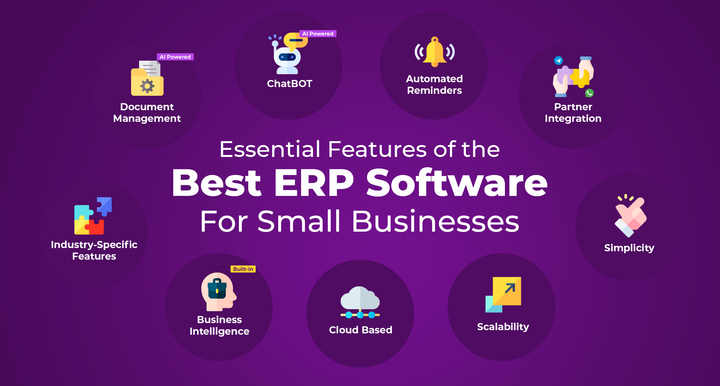
Scalability: Easily scale the system as the business grows—adding users, modules, or locations.
-
Cost Control: Identify unnecessary expenses, track cash flow, and improve budgeting with centralized data.
-
Improved Customer Service: Manage leads, support tickets, and customer data more effectively.
A good ERP system acts as the digital backbone of a business—bringing together all departments and streamlining operations from end to end.
Key Trends and Developments in ERP (2024–2025)
The ERP software landscape has evolved rapidly over the past year, especially in areas of integration, automation, and accessibility:
-
AI-Powered Insights: Many cloud-based ERP solutions now include built-in artificial intelligence (AI) and machine learning to analyze data patterns, forecast trends, and recommend actions. (Example: Zoho ERP AI updates – March 2025)
-
Mobile ERP Applications: There’s been a sharp increase in mobile-friendly ERP systems, allowing users to access dashboards and reports from anywhere.
-
Modular Solutions: In 2024, providers increasingly offered modular ERP packages where small businesses can pay only for the features they need (e.g., QuickBooks Advanced ERP launched a modular pricing model in August 2024).
-
Data Security Enhancements: Due to increased cyber threats, ERP vendors have added advanced encryption, multi-factor authentication, and role-based access controls.
-
Green ERP: Sustainability tracking features are gaining attention—businesses can now monitor their environmental impact as part of supply chain management.
These updates reflect a broader move towards affordable, agile, and intelligent systems tailored to the needs of small businesses.
Government Regulations and ERP Relevance
In many countries, regulatory compliance now mandates greater transparency and accuracy in financial and operational reporting—something ERP systems can directly support.
Examples of regulation-driven ERP adoption:
| Country | Regulatory Requirement | ERP Benefit |
|---|---|---|
| India | GST (Goods and Services Tax) | ERP automates GST filing, tracking, and audit trails. |
| USA | Sarbanes-Oxley (SOX) Compliance | Provides audit logs, access control, and financial transparency. |
| UK | Making Tax Digital (MTD) | Helps small businesses prepare and file digital tax records. |
| EU | GDPR Compliance | ERP ensures personal data is handled securely and ethically. |
Many ERP vendors now build compliance tools directly into their platforms, helping small businesses avoid fines or penalties while maintaining better records.
Recommended ERP Tools and Resources for Small Businesses
There’s a growing selection of ERP tools specifically designed with small business needs in mind. Below are some popular platforms and useful resources:
Cloud-Based ERP Software for Small Businesses
| ERP System | Notable Features | Best For |
|---|---|---|
| Zoho ERP | Modular apps (CRM, finance, HR), AI features | Service-oriented SMBs |
| Odoo | Open-source, customizable modules | Tech-savvy or product-focused businesses |
| SAP Business One | Deep inventory and financial tools | Manufacturing, retail, distribution |
| QuickBooks Advanced | Strong accounting with ERP add-ons | Finance-focused SMBs |
| NetSuite ERP | Scalable, robust reporting | Fast-growing businesses |
Additional Tools and Resources
-
GST/Tax Calculators – For Indian SMBs using ERP (available via ClearTax, Razorpay)
-
Process Mapping Templates – Available free from Lucidchart or Miro
-
Inventory Management Templates – Excel-based tools or integrated ERP modules
-
ERP Readiness Assessment Tools – Offered by vendors like Oracle, SAP
Selecting the right ERP depends on business size, industry, and current operational needs. Many platforms offer free demos or trials to help businesses explore options before committing.
Frequently Asked Questions
What is the average cost of ERP software for small businesses?
Costs vary based on features, users, and deployment type. Cloud ERP plans often start at $20–$200/month per user. Some open-source options like Odoo can be free with limited modules.
Can small businesses use ERP systems without an IT team?
Yes. Many cloud ERP systems are designed to be user-friendly with minimal IT support. Vendors usually provide onboarding, training, and helpdesk services.
What’s the difference between ERP and accounting software?
Accounting software focuses only on finance. ERP covers all business areas—finance, inventory, HR, CRM, operations—under one system.
How long does ERP implementation take?
Depending on business size and system complexity, implementation may take from a few weeks (for basic setups) to several months (for multi-module or custom solutions).
Is ERP necessary for very small businesses (less than 10 employees)?
It depends. Micro-businesses may find simple accounting or inventory tools sufficient. But for growing businesses managing multiple functions, ERP offers long-term benefits in efficiency and organization.
Final Thoughts
ERP software is no longer a luxury for large enterprises—it’s a practical tool for small businesses aiming to operate more efficiently, scale sustainably, and stay competitive in a digital economy. With increasing access to cloud-based, modular, and affordable ERP solutions, small businesses can integrate all their operations in one platform.
Whether you're managing inventory, automating payroll, or tracking customer interactions, an ERP system provides a clear structure that helps your business thrive. As compliance requirements grow and digital transformation accelerates, embracing ERP could be one of the smartest strategic moves for small businesses in 2025.